

Further information
ICRAR
Gravity discovery centre
Science education centre in Gin Gin.
Resources
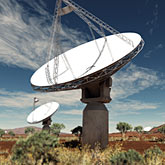 Astronomy and Astrophysics are among the oldest of sciences, and are concerned with the study of the origin, composition and evolution of the universe on a multitude of length and time scales.
Modern astronomers have a wide variety of windows on the Universe, including most parts of the electromagnetic spectrum (optical, radio, infrared, X-ray and gamma-ray astronomy) as well as more exotic probes such as neutrino astronomy.
Many open problems remain, including the nature of dark matter and dark energy that seem to dominate the universe.
The astronomy and astrophysics stream of the physics major provides a strong grounding in modern astronomy and astrophysics, and also in physics and mathematics, essential tools for a modern astronomer or astrophysicist.
Level 1 and 2
In addition to an introduction to astronomy and astrophysics, the first two Levels include a thorough grounding in topics in modern physics and mathematics that form the cornerstones of current astronomical and astrophysical research. These include quantum mechanics, electromagnetism, thermodynamics, statistical physics, nuclear physics and particle physics. The focus shifts strongly to astronomy and astrophysics at Level 3.Level 3
Level three includes study of modern topics in astronomy and astrophysics, such as cosmology, galaxies and their evolution, black holes and active galaxies, stellar birth and evolution, neutron stars and supernovae, planetary astronomy, radiation mechanisms and astronomical techniques.Furthermore, the grounding in physics is further strengthened with the study of modern optics, classical mechanics, electrodynamics, special relativity, signals and noise, particle physics and mathematical physics.
Students are encouraged to consider a Bachelor of Science with a double major: the Astronomy and Astrophysics stream of the Physics major, and a second major in Mathematics, Computer Science, or Engineering Science.
Students with an exceptional entry score (ATAR or equivalent) are encouraged to consider undertaking the Bachelor of Philosophy (Honours) degree. This offers a challenging research-oriented academic program that will be individually designed, focussing on your chosen area of astronomy and astrophysics. This course is unique in Western Australia, and represents an exciting, distinctive experience for outstanding students.
University information
CRICOS Code: 00126G
